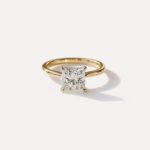
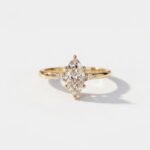
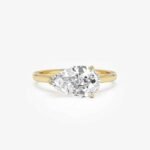
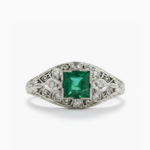
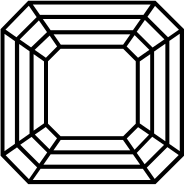
 Asscher
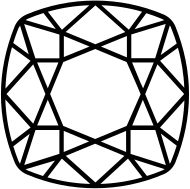 Cushion
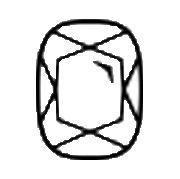 Elongated Cushion
 Emerald
 Marquise
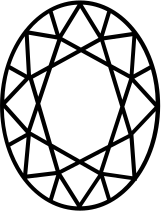 Oval
Oval Pear
Pear Princess
 Radiant
 Round cut Diamond ring
 Toi et moi
 Three Stones
 Halo Engagement Rings
 Hidden Halo
 Nature
 Pave
Pave
 Chevron Wedding band
 Eternity Wedding band
 Curved Wedding band
 Pave Wedding band
 Classic Wedding band
 Diamonds Wedding band
 Designer Wedding band

While the heart may choose the diamond’s shape, the mind must be assured of its quality. This assurance comes in the form of a diamond grading report, an independent, scientific document that serves as the stone’s blueprint. Understanding this report, and the institutions that issue it, is a crucial step in making a confident and informed investment. In the evolving market of lab-grown diamonds, this knowledge has become more vital than ever.
A Refresher on the 4Cs of Diamond Quality

The universal language used to describe a diamond’s quality is the 4Cs, a standard developed by the Gemological Institute of America (GIA). These four metrics provide an objective framework for comparing one diamond to another:
- Cut: Often considered the most important ‘C’, cut refers not to the shape, but to the quality of a diamond’s angles, proportions, symmetry, and polish. An excellent cut is what unlocks a diamond’s ability to interact with light, creating its brilliance, fire, and scintillation.
- Color: This grade measures the absence of color in a diamond on a scale from D (colorless) to Z (light yellow or brown). The less color a diamond has, the rarer and more valuable it is generally considered.
- Clarity: Clarity evaluates the presence of internal characteristics called ‘inclusions’ and external ones called ‘blemishes.’ The scale ranges from Flawless (F) to Included (I), with fewer imperfections commanding a higher value.
- Carat: Carat is a measure of weight, where one carat equals 200 milligrams. While it influences size, the diamond’s cut and shape will determine its face-up dimensions.
The Role of the Gemological Certificate

A diamond grading report, or certificate, from a reputable and independent laboratory is a non-negotiable component of any significant diamond purchase. This document provides an unbiased, third-party assessment of the diamond’s 4Cs and other identifying characteristics, such as its measurements and any treatments it may have undergone. It is the definitive proof that the diamond is what the seller claims it to be, protecting the consumer and ensuring the stone’s value.
GIA vs. IGI: Understanding the Key Players for Lab-Grown Diamonds
For lab-grown diamonds, two gemological laboratories are primarily recognized in the industry: the Gemological Institute of America (GIA) and the International Gemological Institute (IGI).
- GIA (Gemological Institute of America): Widely regarded as the world’s foremost authority in gemology, GIA created the 4Cs and is known for its incredibly strict, consistent, and unbiased grading standards. For decades, a GIA report has been considered the “gold standard” in the diamond industry, particularly in the high-end market for natural stones. GIA began grading lab-grown diamonds in 2007, applying its rigorous standards to these modern gems.
- IGI (International Gemological Institute): IGI has established itself as a global leader in the certification of lab-grown diamonds. It is highly respected and widely used by producers and retailers in the lab-grown market. While some in the industry perceive IGI’s grading as slightly more lenient than GIA’s, particularly in color and clarity, it provides a reliable, comprehensive, and transparent report. IGI certification services also tend to be more affordable, which can translate to better value for the consumer.
The GIA Shift of 2025: What “Premium” and “Standard” Really Mean
In a significant move that is reshaping the lab-grown diamond market, GIA has announced it will no longer use its traditional, detailed 4Cs grading system for laboratory-grown diamonds. Instead, colorless to near-colorless lab-grown diamonds will receive a simplified report with broader quality descriptors, such as “Premium” or “Standard”.
GIA’s stated rationale for this change is to create a clearer distinction between the natural and lab-grown diamond markets, arguing that since lab-grown diamonds are mass-produced, more than 95% fall into a very narrow range of high quality, making detailed grading less necessary than for the vast spectrum of natural diamond qualities.
For the consumer, this shift has a critical implication: a GIA report for a lab-grown diamond will no longer provide the granular detail needed to compare two stones on paper. Two diamonds both classified as “Premium” could have subtle but meaningful differences in their actual color or clarity that are no longer specified. This creates an information gap. While the certificate still validates the diamond’s authenticity and general quality tier, it no longer tells the whole story.
This industry evolution places a new and profound emphasis on the role of the jeweler. The simplified GIA reports create a “trust gap,” which must be filled by the retailer’s expertise, curation, and transparency. In the past, the certificate served as the ultimate, independent authority. Now, a new “trust triangle” has formed, where confidence in a purchase must be built upon three equally important pillars: the certificate’s general validation, the jeweler’s transparent information, and the buyer’s own visual confirmation.
This is precisely where a modern, customer-centric jeweler becomes an indispensable partner. A business model that provides high-resolution photos, 360-degree videos, and detailed CAD images of the actual stone and ring being considered does more than just sell a product; it fills the information void left by the new GIA reports. It empowers the buyer to see the nuances of the diamond for themselves, validating the certificate’s broad claim and cementing the jeweler’s role as a trusted, transparent guide in this new landscape. The power shifts from a reliance on a single document to a collaborative process of verification, ensuring the buyer has absolute confidence in the beauty and quality of their chosen stone.