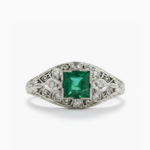
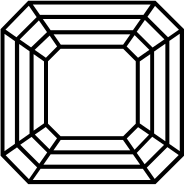
 Asscher
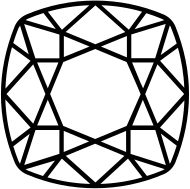 Cushion
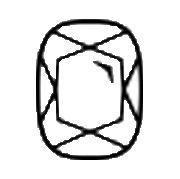 Elongated Cushion
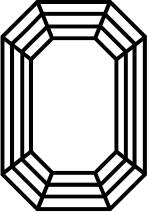 Emerald
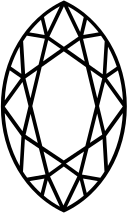 Marquise
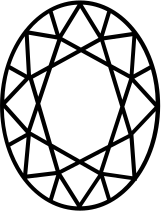 Oval
Oval Pear
Pear Princess
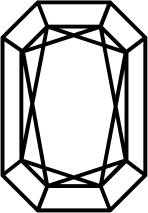 Radiant
 Round cut Diamond ring
 Toi et moi
 Three Stones
 Halo Engagement Rings
 Hidden Halo
 Nature
 Pave
Pave
 Chevron Wedding band
 Eternity Wedding band
 Curved Wedding band
 Pave Wedding band
 Classic Wedding band
 Diamonds Wedding band
 Designer Wedding band
The narrative of the diamond, a stone synonymous with enduring love and unparalleled beauty, is undergoing a brilliant evolution. For centuries, its allure was tied to a story of geological chance—a miracle of pressure and time, unearthed from the depths of the earth. Today, a new chapter unfolds, one written not by nature’s lottery but by human ingenuity. The lab-grown diamond has emerged, not as an alternative, but as the modern, intelligent choice for a new generation of connoisseurs who value transparency, ethics, and exceptional value as much as they do fire and sparkle. This is the story of a perfect stone, perfected.
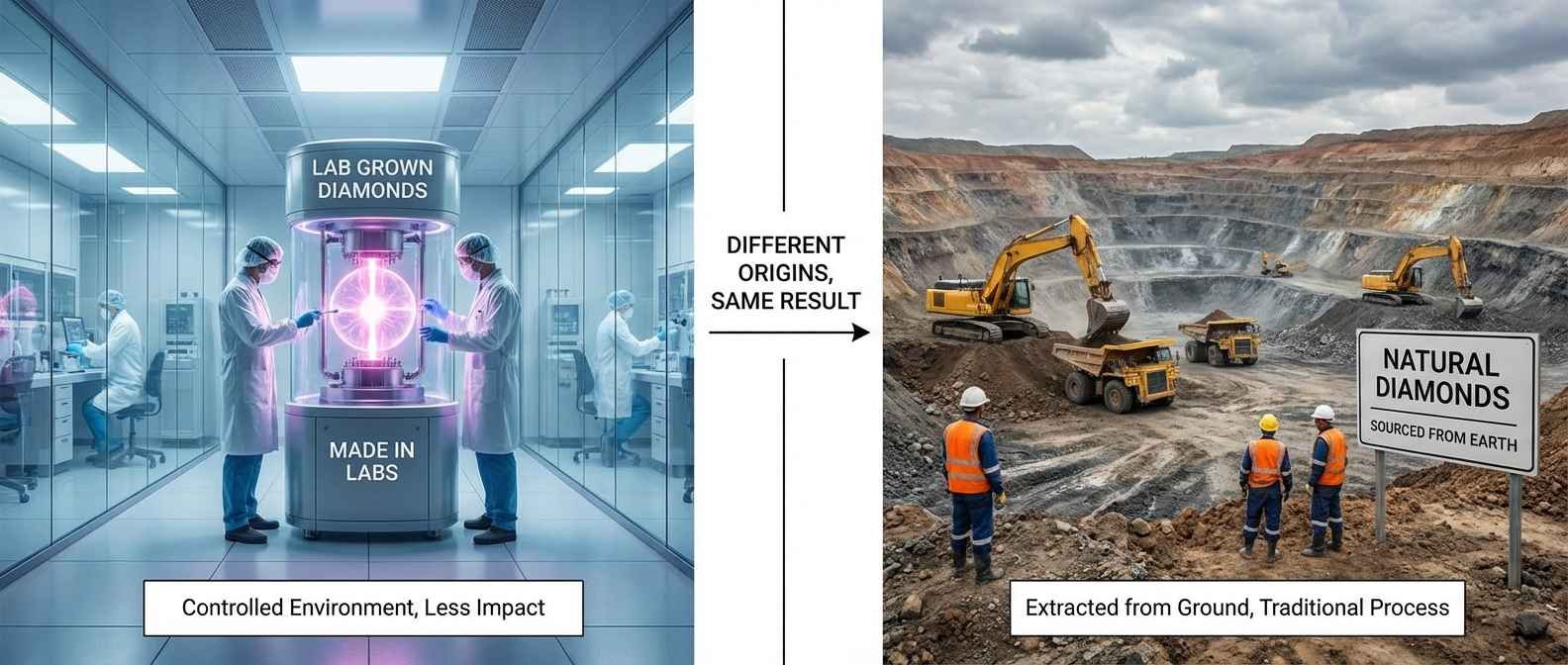
What is a Lab-Grown Diamond? The Science of Identical Brilliance
A laboratory-grown diamond (LGD) is, in the most definitive sense, a real diamond. It is not a “fake,” a “simulant,” or an “imitation” like materials such as cubic zirconia or moissanite, which only mimic a diamond’s appearance. Instead, a lab-grown diamond possesses the exact same chemical, physical, and optical properties as a diamond formed through geological processes. Composed of pure carbon crystallized in an isotropic 3D form, it is visually and structurally indistinguishable from its mined counterpart to the naked eye. Even a trained gemologist often requires specialized equipment to discern its origin.
This fundamental identity was officially recognized by the U.S. Federal Trade Commission (FTC) in 2019. In a landmark revision to its Jewelry Guides, the FTC removed the word “natural” from its official definition of a diamond. The definition now simply reads: “a mineral consisting essentially of pure carbon crystallized in the isometric system”. This ruling affirmed what science has long held to be true: a diamond is a diamond, regardless of its origin. Whether cultivated in a state-of-the-art facility over several weeks or formed in the earth’s mantle over billions of years, the resulting material is identical, exhibiting the same hardness, brilliance, and timeless allure.
From Seed to Stone: The Art of Diamond Creation
The creation of a lab-grown diamond is a marvel of technology that replicates the extreme conditions found deep within the earth. Scientists use two primary methods to cultivate these gems, each beginning with a “diamond seed”—a microscopic slice of a pre-existing diamond that provides the crystalline template for growth.
High Pressure/High Temperature (HPHT) The HPHT method, first developed in the 1950s, is essentially a microcosm of the earth’s mantle. The process begins by placing a diamond seed into a capsule with a source of pure carbon, typically graphite. This capsule also contains a proprietary mixture of metals, known as a metal flux, which includes elements like iron, nickel, and cobalt. The capsule is then placed inside a specialized press—such as a belt, cubic, or split-sphere (BARS) press—which subjects it to immense pressures (approximately 5-6 GPa) and extreme temperatures (around 1,300–1,600°C).
Under these conditions, the metal flux melts, dissolving the carbon source. The carbon atoms then migrate through the molten metal and crystallize onto the cooler diamond seed, atom by atom, replicating its lattice structure. Over a period of several days to weeks, a new, rough diamond forms around the original seed. The HPHT process can also be used to enhance the color of certain diamonds, both natural and lab-grown, by altering their atomic structure.
Chemical Vapor Deposition (CVD) The CVD process, developed in the 1980s, is often likened to “3D printing with gas” and is inspired by the way diamonds form in interstellar gas clouds. This method begins with placing a diamond seed (or a plate of multiple seeds) inside a vacuum chamber. The chamber is filled with a mixture of hydrogen and a carbon-rich gas, typically methane. This gas mixture is then heated to very high temperatures (around 700–1,200°C) and ionized using technology like microwaves to create a plasma cloud.
Within this plasma, the gas molecules break down, and pure carbon atoms begin to “rain down” and deposit onto the diamond seed. Layer by layer, the carbon atoms bond to the seed, extending its crystalline structure and growing a larger diamond. The process is stopped periodically to polish away any non-diamond carbon (graphite) that may have formed, ensuring the purity of the final crystal. The CVD process typically takes several weeks to produce a gem-quality diamond.
Once the rough diamond is fully grown by either method, it is then cut and polished by master artisans using the same techniques and precision applied to mined diamonds, unlocking its inherent fire and brilliance.
The Unmistakable Advantages of a Modern Marvel
The choice of a lab-grown diamond is an informed one, offering a suite of advantages that align with the values of the modern consumer.
Exceptional Value: The most significant practical benefit is the price. Due to a more efficient and shorter supply chain, lab-grown diamonds are typically 30-50% less expensive than mined diamonds of equivalent quality as graded by the 4Cs (cut, color, clarity, and carat). This remarkable value proposition empowers buyers, allowing them to select a significantly larger or higher-quality diamond for their budget without compromising on authenticity or beauty.
Ethical and Environmental Integrity: The traditional diamond industry has long been shadowed by ethical concerns, including the trade of “conflict diamonds” and exploitative labor practices. Lab-grown diamonds offer a definitive solution, as their controlled origin guarantees they are 100% conflict-free. Environmentally, the process of creating a diamond in a lab avoids the extensive land disruption and ecological impact associated with large-scale mining operations. While the creation process is energy-intensive, the industry is making significant strides toward sustainability, with many leading laboratories now operating on renewable energy sources like solar power.
The fundamental distinction between a lab-grown and a mined diamond is not one of substance, but of story. The value of a mined diamond is rooted in a narrative of ancient rarity, a geological lottery played out over billions of years. The value of a lab-grown diamond, conversely, is derived from a narrative of human ingenuity, ethical progress, and accessible luxury. This shift in narrative is profound. The choice is no longer about the physical object itself—for the objects are identical—but about which story resonates with the buyer’s personal values. It is a choice between a story of the earth’s past and a story of humanity’s future. This reframing moves the conversation beyond “real versus fake” and into a more meaningful dialogue of “traditional versus progressive,” empowering the consumer to select the stone whose story they wish to wear and tell.
| Feature | Lab-Grown Diamonds | Mined Diamonds |
| Origin | Created in a controlled laboratory environment using advanced technology. | Formed deep within the Earth’s mantle over billions of years and brought to the surface via volcanic eruptions. |
| Creation Process | High Pressure/High Temperature (HPHT) or Chemical Vapor Deposition (CVD). | Natural crystallization of carbon under extreme heat and pressure. |
| Time to Form | A few weeks to a couple of months, depending on the desired size. | 1 to 3.3 billion years. |
| Chemical & Physical Properties | Identical. Pure carbon crystallized in an isometric system. Same hardness (10 on the Mohs scale), brilliance, fire, and scintillation. | Identical. Pure carbon crystallized in an isometric system. Same hardness (10 on the Mohs scale), brilliance, fire, and scintillation. |
| Price/Value | Approximately 30-50% less expensive than mined diamonds of comparable quality, offering significantly more value for the same budget. | Price is determined by the 4Cs and market factors, with a premium placed on rarity and natural origin. |
| Ethical Considerations | Guaranteed 100% conflict-free due to a transparent and controlled supply chain. | The Kimberley Process aims to prevent the trade of conflict diamonds, but traceability can still be a concern. Mining can be associated with labor exploitation. |
| Environmental Impact | Significantly less land disruption. The process is energy-intensive, but many producers are moving toward renewable energy sources. | Requires extensive land excavation and significant water and energy usage. Can lead to habitat destruction and soil erosion. |
| Resale Value | As a newer product, the long-term resale market is still developing and has more uncertainty compared to natural diamonds. | Generally retain a portion of their value over time, though resale value is typically less than the initial retail price. |